
When buying large-diameter spiral steel pipes, don’t focus on price alone. Choosing the wrong manufacturer can lead to serious problems, such as cracked weld seams, insufficient wall thickness, and delayed deliveries. The resulting losses can far outweigh any savings from a lower price.
This article walks you through every step of the purchasing process, explaining what to check, what to look for, and how to determine whether a manufacturer meets your requirements.
I. First, Be Clear About What You Need
| What You Need to Confirm | How to Specify It | Why It Matters |
|---|---|---|
| Applicable Standard | API 5L / GB/T 9711 / SY/T 5037 / ASTM A252 | Different standards have different quality requirements, which directly affect which manufacturers are qualified to supply your pipes. |
| Steel Grade | For example: X42, X52, X60, X70, etc. | Confirm the required grade with the design institute or engineering team rather than making assumptions. |
| Pipe Diameter and Wall Thickness | For example: Φ1020 × 10 mm | Manufacturers have specific production capacity ranges. Specifications beyond their capabilities may be difficult or impossible to produce properly. |
| Corrosion Protection Requirements | 3PE / 3PP / FBE / Coal Tar Epoxy / No Coating | Manufacturers with in-house coating facilities can provide integrated production and coating services, helping ensure more consistent quality and faster coordination. |
| Required Delivery Date | Specify exact delivery dates for each batch. | Large-diameter pipes have relatively long production lead times. During peak seasons, production scheduling may require a waiting period of 1–2 months. |
PSL1 or PSL2?
In simple terms, PSL1 is generally sufficient for standard engineering projects. For long-distance oil and gas pipelines, high-pressure applications, or high-risk operating environments, PSL2 is required, with significantly stricter inspection and testing requirements.
II. Visit the Manufacturer and Check These Four Key Areas
1. Check the Manufacturer’s Qualifications and Certifications
- Special Equipment Manufacturing License (Pressure Pipeline Components)
- API 5L Monogram License (mandatory for manufacturers producing line pipe)
- ISO 9001 Quality Management System Certification
- For water supply projects, a Drinking Water Hygiene License may also be required.
Practical Tip: Ask the manufacturer to provide scanned copies of its certificates and verify their authenticity on the relevant official websites. Pay particular attention to the “Scope of Products” listed on each certificate to ensure it covers the pipe diameters and steel grades you intend to purchase.
Many manufacturers hold certificates, but their certified product scope may not actually cover your required pipe diameter or steel grade.
2. Inspect the Production Lines
- What is the maximum pipe diameter the production line can handle?
- If you need Φ1220 mm pipes but the manufacturer’s maximum production capacity is only Φ1020 mm, rule them out immediately.
- Does the manufacturer use double-sided submerged arc welding (DSAW)?
- Spiral steel pipes must be welded on both the inside and outside. Manufacturers using single-sided welding should not be considered.
- Is an automatic weld seam tracking system installed?
- This equipment helps minimize weld seam deviation and maintain consistent welding quality.
- Where does the raw steel plate come from?
- Confirm whether the steel plates are sourced from major steel mills such as Baowu, Ansteel, or HBIS, and whether the manufacturer can provide material certificates and heat numbers for traceability.
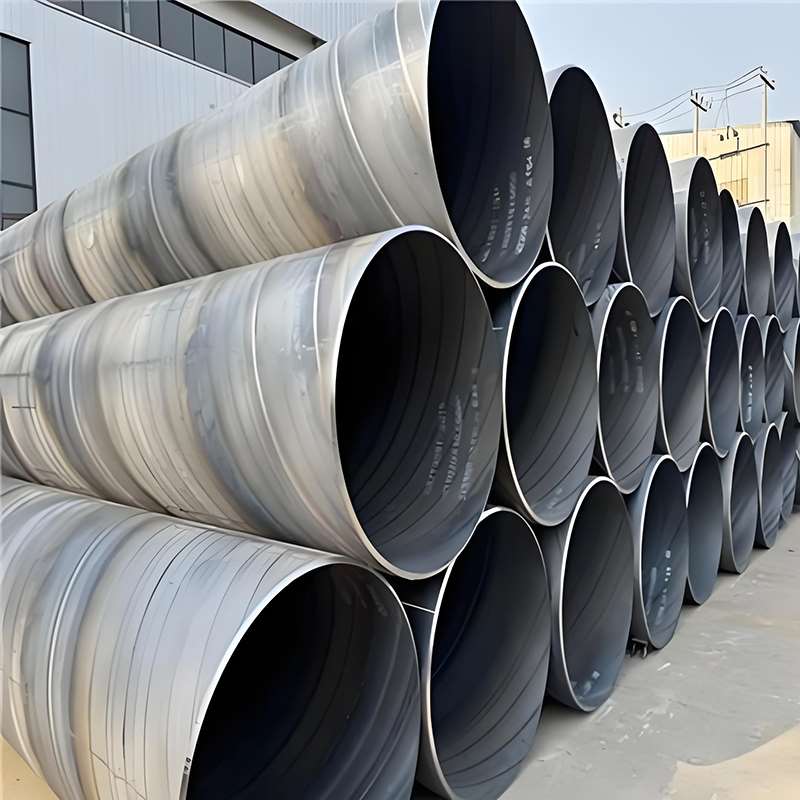
A Practical Tip: Pay attention to the workshop floor and finished pipe storage areas. Well-managed manufacturers typically store pipes neatly in designated areas according to specifications, with clear identification and pipe numbers. If pipes are piled up randomly, effective quality traceability may be difficult.
3. Check the test results
| Inspection Item | What a Qualified Manufacturer Should Do |
|---|---|
| Ultrasonic Testing (UT) | Perform 100% inspection of every pipe weld seam, rather than relying on random sampling. |
| Radiographic Testing (RT) | For PSL2 pipes, conduct full inspection or sampling at the percentage specified by the applicable standard. |
| Hydrostatic Testing | Pressure-test every pipe individually and maintain the required pressure for the specified holding time (typically ≥10–15 seconds). |
| Coating Holiday Detection | Perform 100% spark testing to check the entire coated surface for defects. |
Practical Tip: Ask the manufacturer to show you the original inspection reports for its most recent batch of products with the same specifications as your order. If they cannot provide them, or if the test results look unusually perfect, be cautious.
4. Assess the Manufacturer’s Delivery Capability
- How many production lines does the manufacturer operate, and what is its daily production capacity?
- What is the current production schedule? How far in advance are production slots already booked?
- Does the manufacturer have established logistics partners or a dedicated transport fleet? Large-diameter steel pipes require specialized transportation arrangements and cannot be handled by ordinary trucks.
- Ask for relevant project references: Has the manufacturer completed orders similar to yours in the past two years? Request copies of relevant contracts or contact details of previous customers for verification.
A Common Pitfall: Some manufacturers accept orders despite lacking sufficient production capacity, then secretly subcontract production to smaller factories and put their own brand or markings on the products.
To avoid this, make sure the contract clearly states: “The Manufacturer shall not subcontract or outsource any part of the order without the Buyer’s prior written consent.”
III. Different Projects Require Different Priorities
| Project Type | Key Points to Focus On |
|---|---|
| Long-Distance Oil and Gas Pipelines | API 5L PSL2 certification, full weld seam radiographic testing (RT), hydrostatic test records, and relevant pipeline project experience are all essential. |
| Municipal Heating and Water Supply | Whether the manufacturer has its own coating production line, whether it holds the required drinking water hygiene certification, and the quality of pipe-end beveling. |
| Piling and Structural Applications | Outside diameter accuracy, straightness, and the availability of suitable straightening equipment. Dimensional inaccuracies can prevent pipes from being driven into the ground properly. |
IV. Include These Six Requirements in the Contract Before Signing
1. Require Recent Inspection Reports for the Same Specifications
- Ask for actual inspection reports from a recently manufactured batch with the same specifications as your order, not generic templates.
2. Allow Third-Party Inspections at the Factory
- Agree in advance that third-party inspections are permitted, including resident inspection or unannounced factory inspections.
3. Clearly Define Wall Thickness Acceptance Criteria
- Specify the allowable negative tolerance, the number and locations of measurement points, and how out-of-tolerance products will be handled.
4. Specify Response Times for Quality Issues
- Clearly define how many days the manufacturer has to send personnel to the site, who bears the transportation costs for returns or replacements, and how compensation for work stoppages will be calculated.
5. Require a Unique Identification Number for Every Pipe
- Each pipe must have a unique pipe number corresponding to its Mill Test Certificate (MTC). Verify every pipe against its certificate upon delivery.
6. Prohibit Unauthorized Subcontracting
- The manufacturer must not outsource or subcontract production without the buyer’s prior written consent. Strict penalties should apply in the event of a violation.
A Few Final Points Worth Remembering
1. Be cautious of quotations that are significantly below the market price.
- There is usually a reason behind an unusually low quotation. It may indicate an unclear steel plate source, skipped inspection procedures, or production outsourced to a small factory that simply applies the manufacturer’s own branding.
- A low price does not always mean poor quality, but in the large-diameter spiral steel pipe industry, an unusually low price often comes with quality risks.
2. Use a scoring sheet to evaluate manufacturers objectively.
- Turn the four evaluation areas above—qualifications, production lines, inspection capabilities, and delivery capabilities—into a single scoring sheet. Have each manufacturer complete the same evaluation, and you will be able to see clearly which suppliers meet your requirements and which do not.
- Don’t choose a manufacturer based on gut feeling. Make your decision based on facts and measurable data.