
Many people search for this question expecting a definitive answer, such as “the maximum diameter is X mm.” However, in engineering practice, there is no single fixed maximum diameter for SSAW steel pipes. It needs to be considered from three different perspectives. Once you understand these, you won’t be misled by manufacturers’ marketing claims.
I. The Direct Answer
There is no universally specified “maximum diameter” for SSAW (Spiral Submerged Arc Welded) steel pipes. Based on current industrial practices in China, the maximum diameter can be classified into the following ranges:
| Diameter Category | Value | Description |
|---|---|---|
| Commercial Supply Limit | Φ3620 mm (some manufacturers offer up to Φ4064 mm) | The typical range of diameters available for regular quotation, bulk production, and delivery in the market. |
| Verified Manufacturing Capacity Limit | Φ3880 mm (25.4 mm wall thickness) | The largest diameter reportedly manufactured and verified through actual project orders and physical product inspection in China. |
| Production Line Design / Theoretical Limit | Φ4040–4500 mm | The equipment limit of specific production lines, not a specification that manufacturers can generally supply. |
II. Why Is There No Fixed Maximum Diameter?
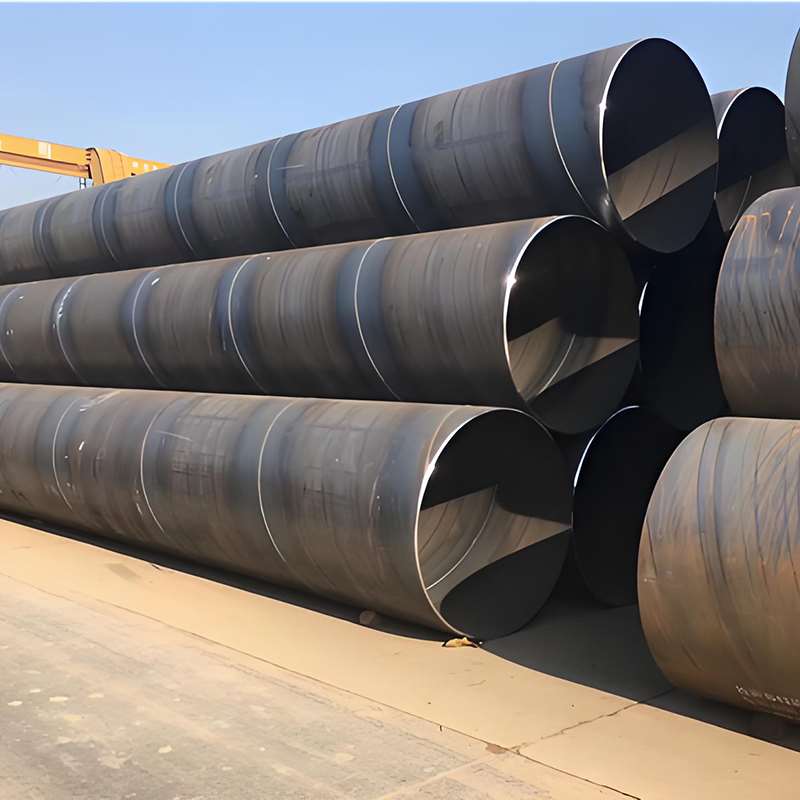
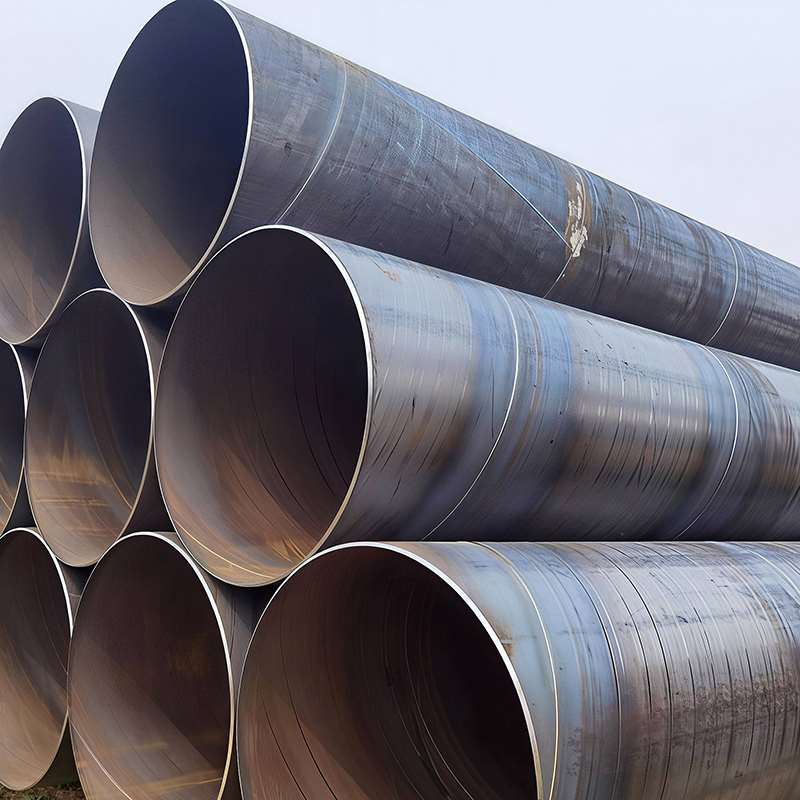
The key difference between spiral welded pipes and longitudinally welded pipes lies in their forming methods. Longitudinally welded pipes are subject to the physical limitation of steel plate width, making it difficult for their diameters to exceed 1,422 mm in most cases. Spiral welded pipes, on the other hand, can be manufactured in a wide range of diameters by adjusting the forming angle within a given strip width. This gives the spiral forming process greater geometric flexibility when producing large-diameter pipes.
However, this flexibility is subject to several constraints in actual manufacturing:
1. Forming Stability
As the pipe diameter increases, the forming angle becomes shallower, making it significantly more difficult to control edge misalignment and forming accuracy. In engineering practice, the ratio of strip width to pipe diameter is generally controlled within a range of 1.3–2.2, corresponding to a forming angle of approximately 45°–65°. Beyond this range, forming stability and dimensional accuracy become increasingly difficult to maintain.
2. Wall Thickness Limit
The wall thickness of conventional SSAW steel pipes generally does not exceed 25.4 mm. When both an extremely large diameter and a heavy wall thickness are required, the bending force needed for forming and the control of springback approach the equipment’s operating limits, significantly reducing process stability.
3. Welding Accessibility and Quality Consistency
When the pipe diameter exceeds 3.5 m, the available working space for internal welding becomes more restricted, and the accuracy of automatic weld tracking decreases. Controlling the accumulation of thermal deformation also becomes more challenging. Additional factors, such as the travel range of the internal welding arm, ventilation inside the pipe, and slag removal, become more complicated, making consistent welding quality harder to achieve.
4. Ovality Control
Large-diameter, thin-wall pipes are more susceptible to secondary deformation during transportation and lifting. After delivery, their dimensional accuracy should be verified through remeasurement rather than automatically assumed to match the factory inspection records. Excessive ovality can directly cause difficulties during field fit-up and lead to a substantial increase in repair rates.
III. Sources and Basis for the Diameter Figures
1. Regular Commercial Supply: Φ3620 mm
- Product catalogs from major SSAW steel pipe manufacturers in China generally list Φ3620 mm (approximately DN3600) as the upper limit for regular supply. Some manufacturers extend this range to Φ4064 mm.
- These figures represent the diameter range that existing production lines can manufacture on a stable basis, schedule for batch production, and deliver in commercial quantities. They also reflect the commonly encountered specification limits when requesting quotations and purchasing SSAW steel pipes in the market.
2. Production Line Design Limit: Φ4040–4500 mm
- Some publications report that the maximum product diameter of the largest domestic double-sided spiral submerged arc welding pipe production lines in China is Φ4040 mm. Technical documents from certain suppliers also claim a maximum diameter of Φ4500 mm.
- These figures reflect the theoretical design parameters or maximum configuration capabilities of specific production lines. Dedicated process development and verification are required before such capabilities can be translated into deliverable products. They should not be regarded as specifications available through regular market supply.
IV. The Role of Standards and Specifications
Steel pipe standards such as API 5L and GB/T 9711 do not specify a maximum permissible diameter. Their purpose is to establish requirements for dimensional tolerances, chemical composition, mechanical properties, non-destructive testing, and inspection, providing a quality framework for SSAW carbon steel pipes of various diameters.
For a specific project, the required pipe diameter is determined by mutual agreement between the buyer and the manufacturer through a technical agreement. These standards contain no corresponding upper diameter limit.
Ultimately, the contractual agreement between the buyer and the manufacturer defines the maximum diameter of SSAW steel pipes for a given project.
V. Practical Implications for Engineering and Pipe Selection
1. Standard Projects
- When the required pipe diameter is within Φ3620 mm, SSAW steel pipes are generally a well-established and readily available option. Buyers have a relatively wide choice of suppliers and can proceed through standard procurement procedures.
2. Extra-Large Diameter Projects (Above Φ3500 mm)
- For projects requiring diameters above Φ3500 mm, buyers should ask suppliers to provide recent supply contracts and project references for pipes of the same or similar specifications. This helps verify whether the manufacturing process has been fully established and validated for batch production, rather than relying solely on the maximum diameter stated in a product catalog.
- If the quoted lead time for a particular specification increases from the usual 3–5 days to 15–25 days, this may indicate that the specification is approaching the supplier’s actual manufacturing capacity limit.
3. Evaluate Diameter, Wall Thickness, and Steel Grade Together
- The manufacturing feasibility of large-diameter SSAW pipes is jointly constrained by wall thickness (generally ≤25.4 mm for conventional production) and steel grade.
- If a project requires a combination of large diameter, heavy wall thickness, or high steel grade (above X80), a dedicated manufacturability assessment is necessary. Alternative solutions, such as longitudinally welded submerged arc welded pipes or segmented structures, may need to be considered.
4. Technical Requirements in the Contract
For large-diameter SSAW steel pipe procurement, the contract should specify more than just the pipe diameter and wall thickness. It should also clearly define requirements for:
- Outside diameter tolerances
- Ovality (recommended ≤1% of the outside diameter)
- Weld seam misalignment
- Pipe-end beveling accuracy
- Minimum spacing between strip butt welds
Clearly defining these requirements helps prevent difficulties during field fit-up and reduces the risk of excessive repair work.