
In oil and gas, water supply, and construction projects such as bridges, spiral steel pipes are widely used due to their high strength and low cost. However, when steel pipes are buried underground or exposed to the atmosphere, corrosion becomes the most critical issue. Without protective coatings, steel pipes can rust through within a few years, leading to leakage and even serious safety accidents.
To extend service life, engineers have developed various anti-corrosion coating systems. In this article, we will clearly explain the main types of anti-corrosion coatings for spiral steel pipes, helping you make the right and accurate choice for engineering or procurement.
Steel pipe corrosion protection is mainly divided into external anti-corrosion coatings (to resist soil, moisture, and stray current corrosion) and internal coatings (to reduce flow resistance and prevent fluid-induced corrosion).
I. External Anti-Corrosion Coatings
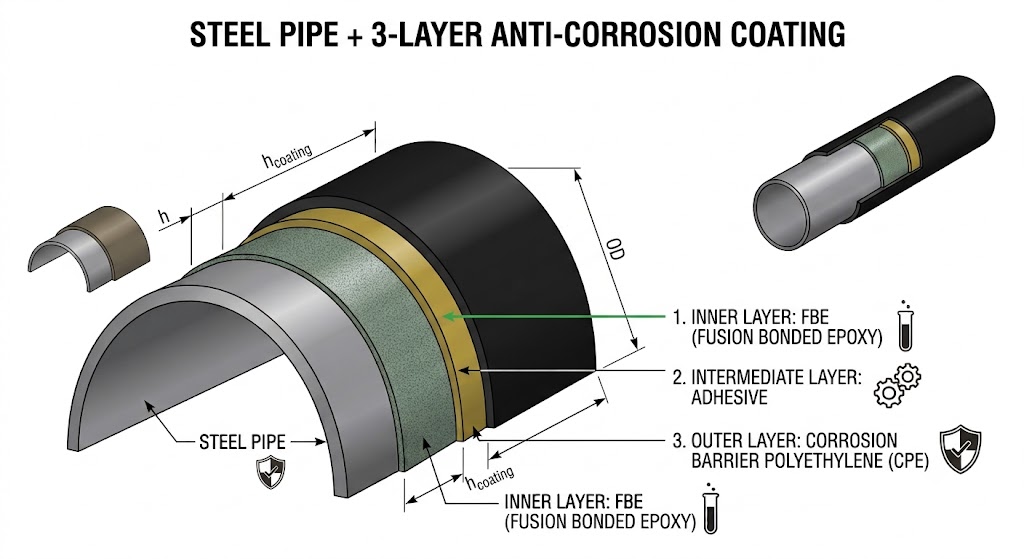
1. 3LPE (Three-Layer Polyethylene Coating)
This is currently one of the most widely used external anti-corrosion systems for long-distance oil and gas pipelines worldwide. It is not a single-layer coating, but a composite structure consisting of three functional layers:
- Bottom layer (FBE – Fusion Bonded Epoxy powder):
Applied directly onto the steel surface, it provides strong adhesion and excellent resistance to cathodic disbondment (the fundamental barrier against corrosion). - Middle layer (adhesive layer):
Acts as a bonding agent, tightly connecting the epoxy layer and the outer polyethylene layer. - Outer layer (PE – Polyethylene):
A tough, durable plastic layer with high mechanical strength. It protects the pipe from moisture ingress and resists impact, scratching, and damage during transportation and backfilling in trench applications.
Advantages: Long service life (over 50 years), excellent resistance to mechanical damage, and outstanding electrical insulation performance.
Applications: Cross-border oil and gas pipelines, harsh soil environments, and highway/railway crossing sections.
2. FBE / Dual-Layer FBE (Single-Layer/Dual-Layer Fusion-Bonded Epoxy Powder)
Epoxy resin powder is evenly sprayed onto the surface of steel pipes heated to 200°C or higher; the powder melts and cures into a hard coating. Dual-layer FBE adds an additional layer of modified epoxy on top to enhance scratch resistance.
- Advantages: Strong adhesion to steel pipes (molecular-level bonding), high-temperature resistance (up to 100°C or higher), and no issues with shielding of cathodic protection current.
- Disadvantages: The coating is relatively thin (several hundred micrometers) and is prone to chipping under strong external impact.
- Applications: Directional drilling and crossing projects (where the coating is not easily scraped off), subsea pipelines in high-salinity and high-humidity environments, and high-temperature transmission pipelines.
3. IPN8710 Polymer Anti-Corrosion Coating
This is an interpenetrating polymer network (IPN) coating formed by the cross-linking of polymer materials such as polyurethane and polystyrene. It cures when applied by brush or spray at room temperature.
- Advantages: Non-toxic, stable anti-corrosion performance, and good adhesion.
- Applications: Urban water supply networks and water supply pipelines.
II. Internal Anti-Corrosion Coatings
Internal anti-corrosion coatings serve two purposes: first, to prevent corrosion; and second, to reduce friction (allowing water or gas to flow faster, thereby saving on electricity costs for pumping or gas transmission).
1. Liquid Epoxy Coating
A thin layer of liquid epoxy resin is sprayed onto the interior of the steel pipe.
Function: Creates a smooth surface. For natural gas pipelines, this is known as a “friction-reducing lining” that can increase flow rate by nearly 10%; for water transmission pipelines, it prevents scale buildup and bacterial growth.
2. Cement Mortar Lining
A layer of cement mortar is applied to the interior of the steel pipe using centrifugal or spray application processes.
Benefits: Low cost. Cement is alkaline and forms a passivating protective film on the inner wall of the steel pipe, preventing rust even if water penetrates the pipe.
Applications: Large-diameter municipal sewage pipes and non-potable water transmission pipes.
III. Comparison Table of Anti-Corrosion Coatings
| Coating Type | Key Advantages | Key Disadvantages | Recommended Application Scenarios |
|---|---|---|---|
| 3LPE (External Coating) | High mechanical strength; longest anti-corrosion service life (>50 years) | Relatively high cost; not suitable for temperatures above 100°C | Onshore long-distance oil & gas trunk pipelines; harsh soil environments |
| FBE (External Coating) | Strong adhesion; excellent heat resistance; compatible with cathodic protection | Thin coating layer; vulnerable to damage from sharp impact during transportation | Directional drilling crossings, offshore pipelines, thermal pipelines |
| IPN8710 (Internal/External Coating) | Non-toxic and environmentally friendly; easy application and construction | Lower wear resistance and pressure resistance compared to 3LPE | Urban potable water supply networks |
| Cement Mortar (Internal Lining) | Low cost; readily available materials; good resistance to groundwater pressure | Heavy weight increases transportation cost; not suitable for gas pipelines | Large-diameter urban water transmission, drainage, and sewage pipelines |