
During the steel pipe procurement process, many buyers encounter a confusing situation: SSAW steel pipes that appear to be the same can vary significantly in price. Quotations from different manufacturers—or even different production batches from the same supplier—may differ by several hundred or even over a thousand yuan per metric ton.
This substantial price gap is not the result of market speculation. Instead, it reflects the hidden costs behind the product. To understand why SSAW steel pipe prices vary so widely, it is essential to examine four key factors: raw materials, applicable standards, inspection requirements, and pipe specifications & manufacturing processes.
I. Hidden Costs Behind the Manufacturing Process
The production of SSAW steel pipe is a continuous forming and submerged arc welding process. As shown in the illustration below, every stage—from steel coil uncoiling and spiral forming to double-sided submerged arc welding and final quality inspection—requires investment in equipment, labor, and quality control. These manufacturing differences ultimately contribute to the variation in production costs and market prices.
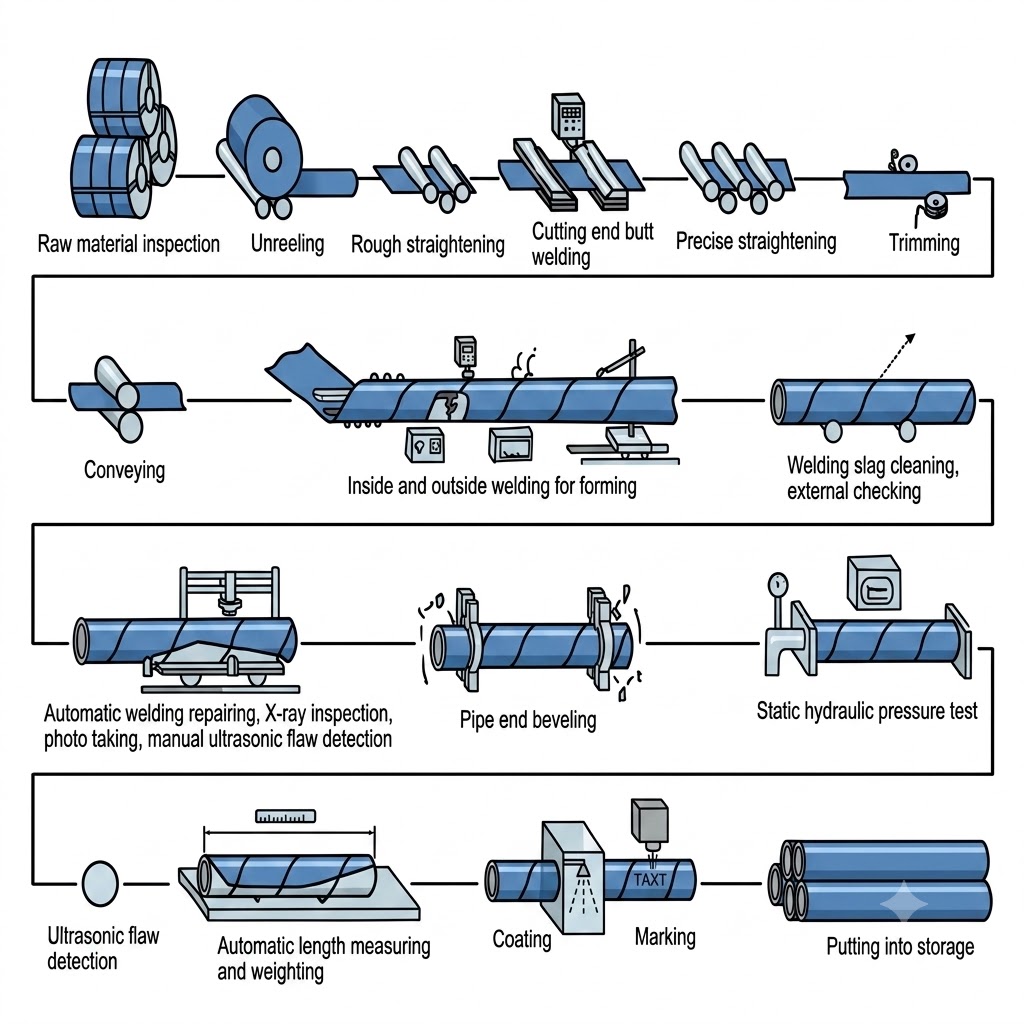
As illustrated in the process flow chart, the real cost difference lies in the inspection and quality assurance stages of production, particularly X-ray inspection, ultrasonic testing (UT), and hydrostatic pressure testing. Omitting or simplifying these procedures can significantly reduce the apparent production cost per metric ton, resulting in a lower selling price.
However, this cost saving comes at the expense of product reliability and can introduce serious safety risks during service.
II. Four Key Factors That Determine the Price of SSAW Steel Pipe
① Raw Material Quality Makes the Difference
SSAW steel pipes are manufactured by spirally forming and welding hot-rolled steel coils. The grade of the steel coil has a direct impact on the base material cost.
- Standard carbon steel grades (e.g., Q235B): Commonly used for piling, dredging, slurry transportation, and other low-pressure applications, offering the most economical solution.
- High-strength structural and line pipe grades (e.g., Q355B, X42, X60, and X80): As the required yield strength increases, steel mills add micro-alloying elements to improve mechanical performance. This significantly increases the raw material cost, often by several hundred to more than a thousand yuan per metric ton.
② The Required Standard Has a Major Impact on Price
The applicable manufacturing standard is one of the most common reasons for large price differences between suppliers. When comparing quotations, buyers should always verify which national or international standard the pipe is manufactured to. Different standards specify different requirements for chemical composition, mechanical properties, dimensional tolerances, welding quality, inspection procedures, and testing methods, all of which directly affect production costs.
| Manufacturing Standard | Typical Applications | Inspection & Testing Requirements | Price Level |
|---|---|---|---|
| SY/T 5037 (China Industry Standard) | Low-pressure fluid transportation, such as wastewater, water supply, and general utility pipelines | Basic quality inspection with relatively low hydrostatic test requirements and wider dimensional tolerances. | Lower (Market baseline) |
| GB/T 9711 (China National Standard) | Natural gas pipelines, oil pipelines, high-pressure water transmission, and district heating networks | Much stricter requirements. Typically requires 100% full-length ultrasonic testing (UT) and X-ray inspection (RT), along with comprehensive mechanical property tests (e.g., impact toughness). | Higher (Typically RMB 300–600 per metric ton more than SY/T 5037) |
| API 5L (International / U.S. Standard for Line Pipe) | International oil and gas transmission pipelines and overseas engineering projects | The most stringent requirements for steel cleanliness, weld quality, non-destructive testing (NDT), and dimensional tolerances. | Highest |
Procurement Warning: Some unscrupulous suppliers may quote a very low price by passing off pipes manufactured to lower industry standards as national-standard products, or by supplying non-standard pipes with excessive negative wall thickness tolerances. Always verify the manufacturing standard, inspection reports, and actual dimensions before placing an order.
③ Inspection Requirements and Pass Rate
The weld seam of an SSAW steel pipe forms a continuous spiral, making its total weld length typically two to three times longer than that of an LSAW pipe of the same length. As a result, weld quality inspection plays a much more critical role in ensuring product reliability.
- Low-priced pipes: Often undergo only basic sampling inspections or, in some cases, merely a visual surface inspection, leaving a much higher risk of undetected weld defects.
- Higher-priced pipes: Are manufactured in strict compliance with applicable standards, requiring 100% full-length radiographic testing (RT), automated ultrasonic testing (UT), and a hydrostatic pressure test for every pipe. If defects such as porosity or cracks are detected, qualified automatic weld repair procedures must be carried out before re-inspection. The cost of advanced NDT equipment, skilled technicians, and repair operations is ultimately reflected in the price per metric ton.
④ Dimensional Tolerances and Wall Thickness Requirements
- Positive vs. Negative Wall Thickness Tolerances: The actual wall thickness of a steel pipe always varies slightly from its nominal thickness. If a project specifies positive tolerance or zero negative tolerance (meaning the actual wall thickness must meet or exceed the nominal value and cannot be thinner), manufacturers must apply much tighter production control and reject more out-of-tolerance products. This leads to a higher production cost and, consequently, a higher selling price.
- Challenges of Large-Diameter and Heavy-Wall Pipes: When the pipe diameter exceeds 1,000 mm and the wall thickness is relatively heavy, the forming equipment is subjected to significantly greater mechanical stress, while welding becomes considerably more demanding. These factors increase manufacturing complexity and can multiply the processing cost.
III. Practical Tips for Buyers to Avoid Costly Mistakes
Don’t Focus Only on the Price per Ton—Align the Specifications First
When requesting quotations, always specify the manufacturing standard (e.g., GB/T 9711-2017) and steel grade (e.g., Q355B) in writing. Never accept vague descriptions such as “Chinese national standard” or verbal promises like “It will be good enough.” Only quotations based on the same technical specifications can be compared fairly.
Verify the Delivery Basis and Wall Thickness Tolerance
Confirm whether the steel pipe will be supplied by theoretical weight or by actual weighed weight. If the quotation is based on theoretical weight, the purchase contract should clearly define the maximum allowable negative wall thickness tolerance (for example, not more than 5%) to prevent excessive wall thickness deviation.
Request Complete Quality Documentation (MTC)
For high-pressure pipelines, structural applications, or other safety-critical projects, always require the manufacturer to provide complete quality documents for the corresponding production batch, including:
- Mill Test Certificate (MTC) for the raw materials
- Weld non-destructive testing (NDT) reports (such as RT and UT)
- Hydrostatic pressure test records
These documents provide traceable evidence that the pipes have been manufactured and tested in accordance with the specified standards before shipment.