
A modern spiral steel pipe production line typically consists of eight core processes, each of which directly determines the final quality of the steel pipe.
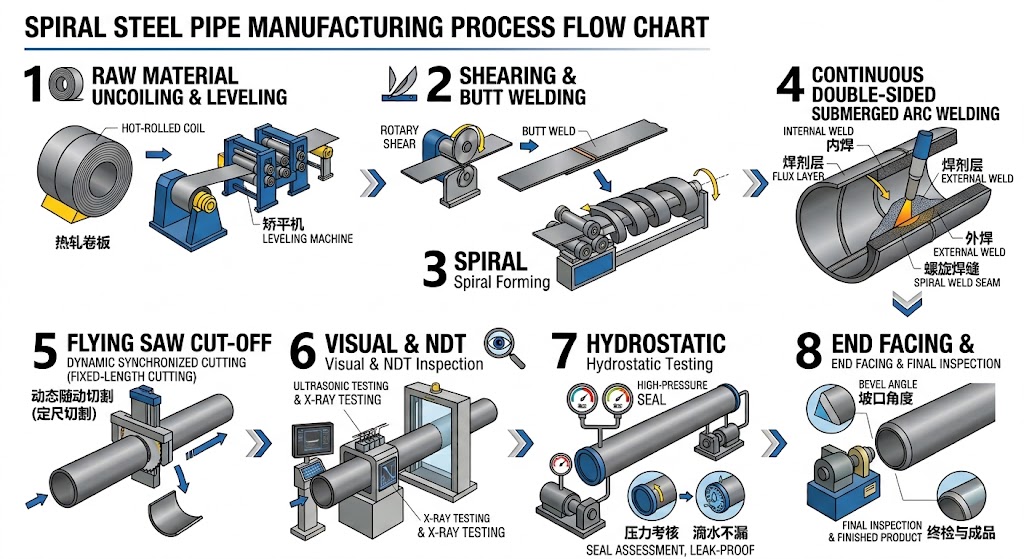
1. Raw material uncoiling and leveling: eliminating internal stress in the steel coil.
Hot-rolled steel coils are first uncoiled by an uncoiler and fed into a leveling machine. The leveling rolls repeatedly press and flatten the strip, removing waves and curvature on the surface to ensure precise geometric accuracy in subsequent processing.
2. Edge trimming and strip end welding:
To ensure uniform pipe wall thickness and diameter, a circular edge trimmer removes irregular edges of the strip. When one coil is nearly used up, the tail end of the previous coil must be joined to the head of the next coil using submerged arc welding, enabling continuous 24-hour production without interruption.
3. Helical forming: geometric deformation stage.
The steel strip is fed into the forming machine and passes through a set of precisely arranged forming rolls. At this stage, the strip is forced into a curved shape and advanced forward at a set forming angle. The originally flat strip is gradually rolled into a hollow cylindrical pipe, similar to a paper tube.
4. Continuous double-sided submerged arc welding: internal and external reinforcement for leak-proof performance.
As the strip is formed into a pipe, welding is carried out simultaneously. Spiral steel pipes adopt double-sided submerged arc welding (SAW), where the welding arc and molten metal are shielded under a thick layer of flux, preventing oxidation.
- Internal welding: The first weld is applied to the inner seam of the pipe.
- External welding: A second weld is then applied to the corresponding outer spiral seam.
Through this double-sided fusion, the weld strength can even exceed that of the base metal.
5. Flying cut-off saw:
The welded pipe is essentially an endless length of continuously produced steel pipe. A computer-controlled flying saw synchronizes with the moving pipe and cuts it precisely to the required length (typically 12 meters per piece) without stopping production.
6. Visual inspection and non-destructive testing:
Freshly cut pipes first undergo visual inspection, followed by automatic ultrasonic and X-ray testing systems. This is equivalent to performing a “B-ultrasound” and “X-ray scan” on the weld seam. Any internal defects such as pores, cracks, or incomplete fusion that are invisible to the naked eye are automatically detected and accurately located by the system.
7. Hydrostatic testing:
Pipes that pass non-destructive testing are sent to a hydrostatic test unit. Both ends are sealed, and high-pressure water is injected into the pipe (pressure varies depending on diameter and application, sometimes reaching tens of MPa). The pipe must withstand the specified pressure for a defined period without leakage or deformation to pass the test.
8. End finishing and final inspection:
A beveling machine cuts a specific angle on both ends of the pipe (typically 30°–35° or 30–35 degrees chamfer) to facilitate on-site welding during installation. After final weighing, measurement, anti-corrosion coating, and marking, qualified spiral steel pipes are ready for shipment.
Why are spiral steel pipes so popular?
Low cost for large diameters:
There is no need for extremely expensive ultra-wide steel plate production lines. By adjusting the forming angle, the same coil width can be used to produce pipes of various diameters.
Higher safety factor:
Spiral weld seams distribute internal stress more evenly in three-dimensional space. Even in extreme failure conditions, the crack propagation tends to follow the spiral path rather than instantly rupturing the entire pipe, reducing the risk of catastrophic failure.
High dimensional accuracy:
Fully automated continuous production with real-time monitoring of wall thickness, outer diameter, and ovality ensures industrial-grade standardization.
Although the total weld length of a spiral steel pipe is approximately 30–100% longer than that of a straight seam pipe of the same length, modern automated double-sided submerged arc welding technology is highly mature. The weld quality and mechanical performance are fully reliable and meet stringent engineering standards.