
Spiral steel pipe: It is like a “rolled paper tube.” A long steel strip is helically wound at a certain inclination angle to form a pipe shape, and its weld seam runs in a spiral line around the pipe body.
Longitudinal submerged arc welded pipe (LSAW): It is like “rolling a flat sheet of paper into a tube.” A single thick steel plate is pressed into a cylindrical shape through forming processes such as JCO or UO forming, and its weld seam is a straight longitudinal line.
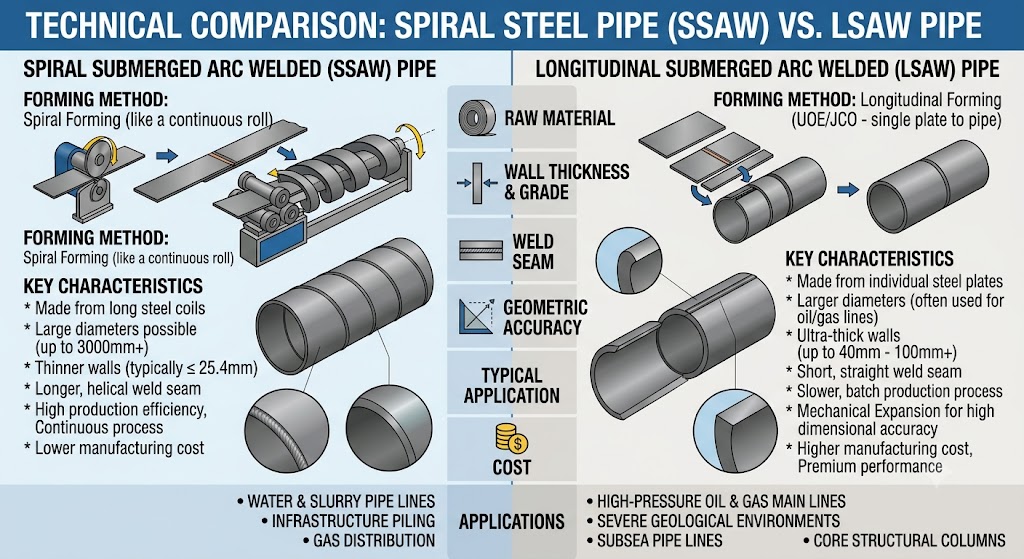
Comparison between spiral welded steel pipe and LSAW steel pipe:
| Comparison Item | Spiral Steel Pipe (SSAW) | Longitudinal Submerged Arc Welded Pipe (LSAW) |
|---|---|---|
| Raw Material | Hot-rolled coil (strip steel) | Heavy steel plate (single cut-to-length plate) |
| Diameter & Wall Thickness | Easily achieves large diameters, but limited wall thickness (typically ≤ 25.4 mm) | Can achieve both large diameters and extra-thick walls (up to 40–100 mm) |
| Steel Grade | Generally used for low to medium grades (e.g., Grade B, X42 to X70) | Suitable for high to ultra-high grades (e.g., X80 and X100) |
| Weld Seam Length | Longer weld seam (30% to 100% longer than longitudinal seam) | Short weld seam (equal to pipe length), straight longitudinal seam |
| Production Efficiency | Continuous production with very high efficiency | Batch production from single plates, multiple processes, lower efficiency |
| Manufacturing Cost | Lower cost (high cost-performance ratio) | Higher cost (typically 20% to 30% more expensive) |
Why Do These Performance Differences Exist?
1. Why is LSAW (Longitudinal) more expensive and stronger?
LSAW pipes are manufactured from a single heavy steel plate that is mechanically pressed into shape. Because a single plate is used, it allows the production of extremely thick-walled pipes (e.g., over 40 mm), which is not feasible for spiral steel pipes.
In addition, LSAW pipes undergo a full mechanical expansion process. This step forcibly calibrates the pipe to an exact circular shape and relieves welding stress. As a result, LSAW pipes offer higher dimensional accuracy, superior resistance to high pressure, better low-temperature performance, and improved corrosion resistance.
2. Why is SSAW (Spiral Steel Pipe) the “cost-performance champion”?
Spiral steel pipes are produced in a continuous process. The tail end of one steel coil is welded to the head of the next, allowing 24-hour uninterrupted production with very high efficiency.
Most importantly, SSAW pipes can produce large diameters using relatively narrow steel strips. There is no need for expensive ultra-wide steel plates specifically rolled for large diameters.
Therefore, in applications involving large diameters and moderate pressure, spiral steel pipes significantly reduce overall material and manufacturing costs.
3. Procurement and Selection Guide: How Should You Choose?
Scenarios Where Spiral-Welded Steel Pipes Are the Preferred Choice:
- Low- to medium-pressure fluid conveyance: Municipal water supply pipelines, sewage networks, and agricultural irrigation.
- General long-distance pipelines: Low-pressure natural gas and coal slurry conveyance in flat, inland regions.
- Structural and Piling Applications: Piling pipes for the foundations of docks, bridges, and elevated structures; underground foundation support pipes.
- Key Reason: In these scenarios, spiral-welded pipes offer more than sufficient strength and can significantly reduce the total project budget.
Scenarios Where Longitudinally Submerged-Arc Welded Pipes Are Essential:
- High-Pressure and Extreme Environments: High-pressure natural gas trunk lines, pipelines in high-intensity seismic zones, and subsea oil pipelines.
- Extra-Thick-Wall Requirements: Used as core load-bearing columns in structural engineering, or for pipelines that must withstand extremely high internal or external pressures (wall thickness greater than 25 mm).
- Stringent Geometric Requirements: Projects with extremely high requirements for pipe ovality and straightness, where extremely precise butt welding is required.
- Key Reason: When facing extreme high pressures and harsh geological conditions, the safety factor and stress resistance of straight-seam pipes are unmatched.