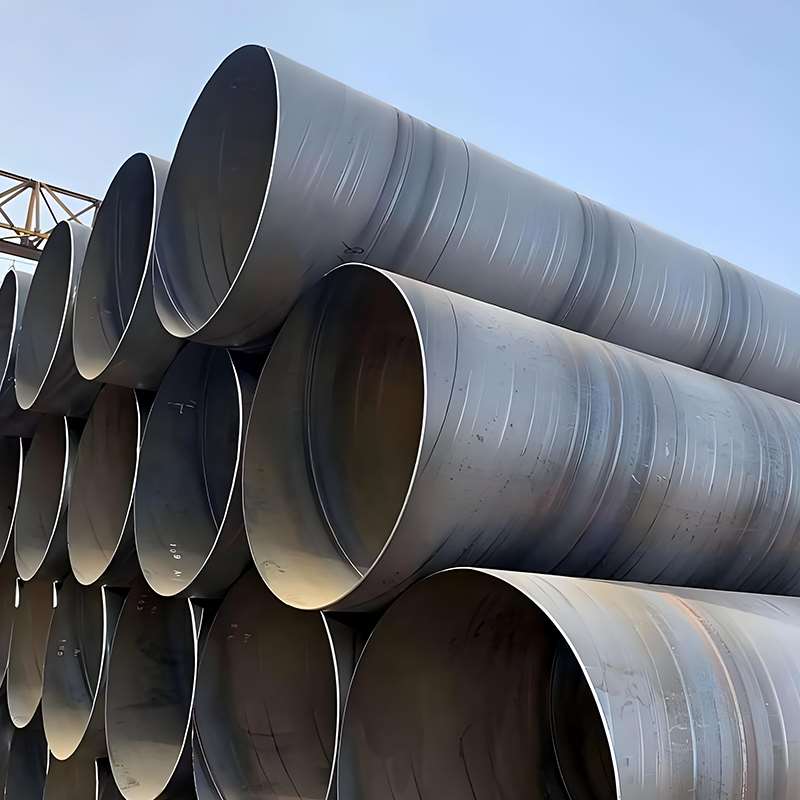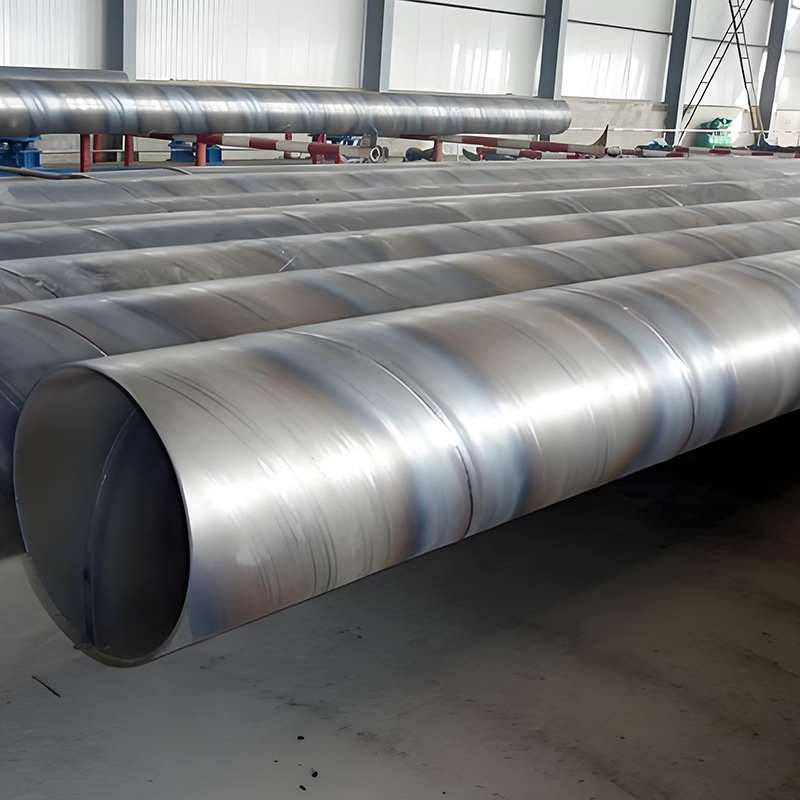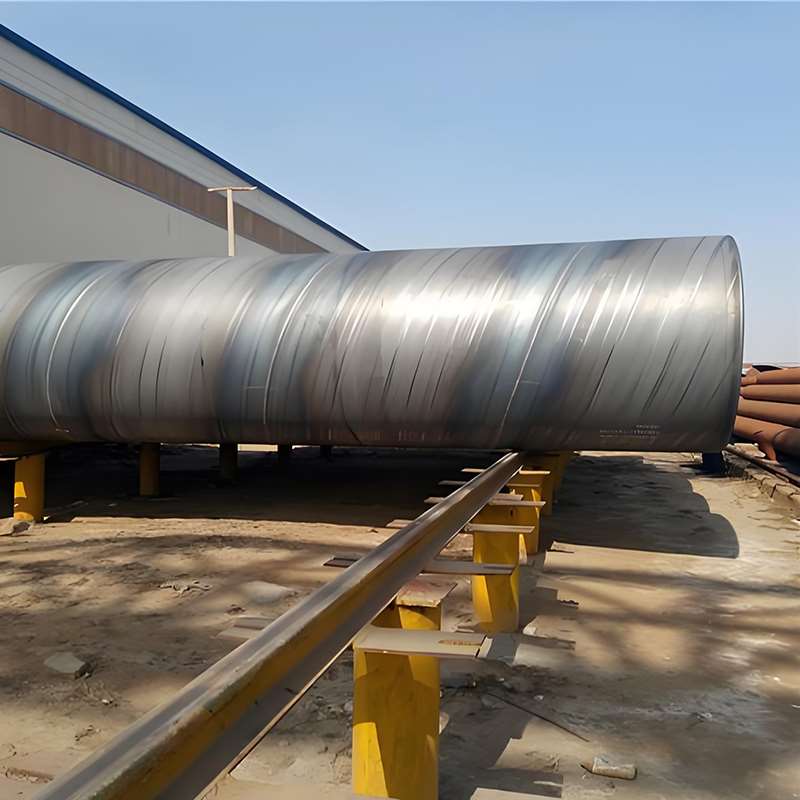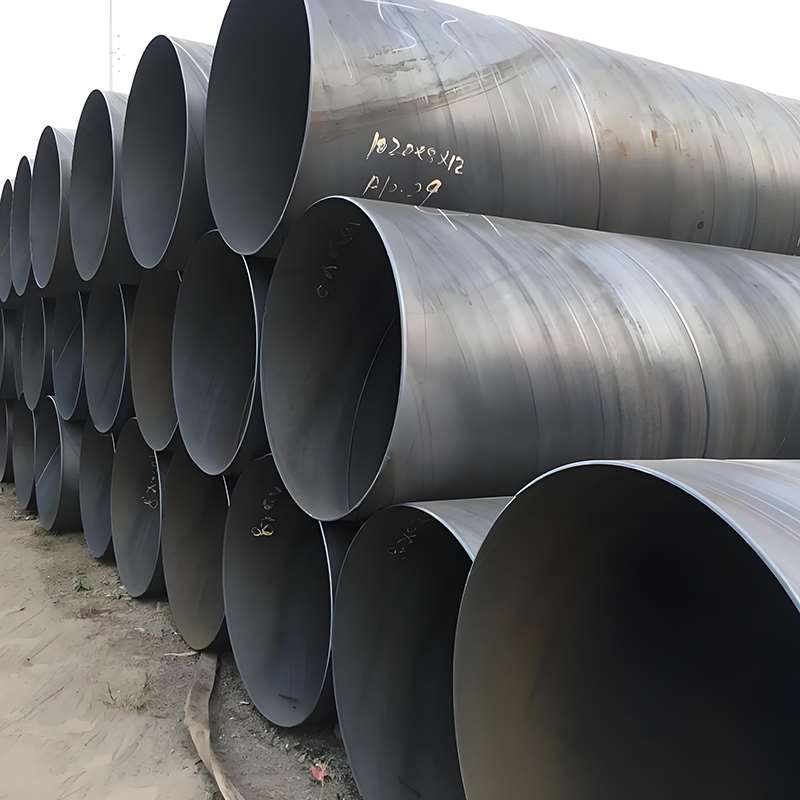
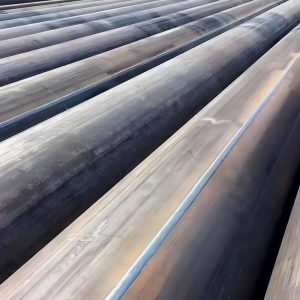
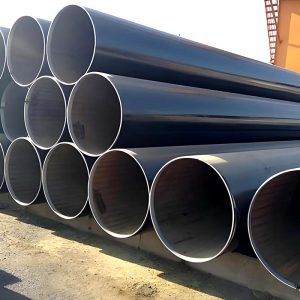
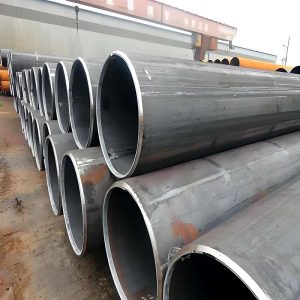
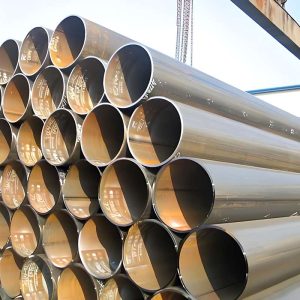
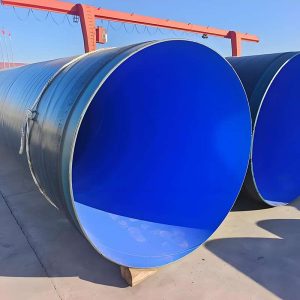
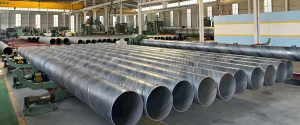
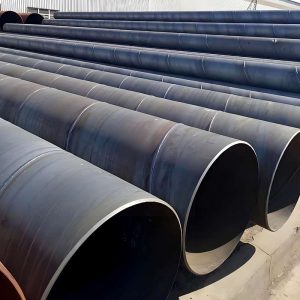
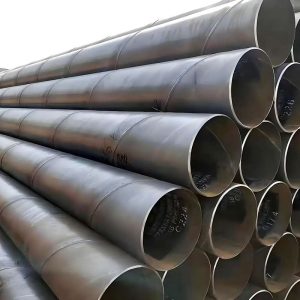
I. Overview of Spiral Steel Pipe
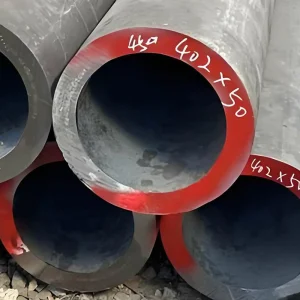
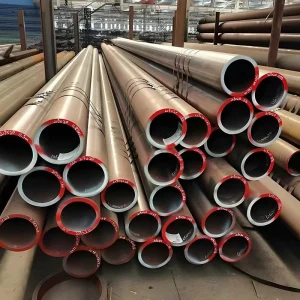
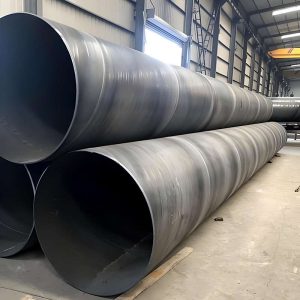
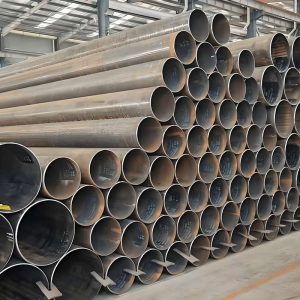
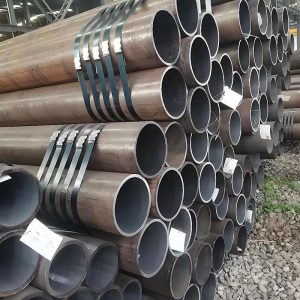
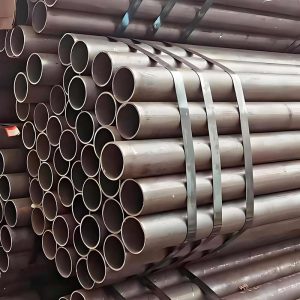
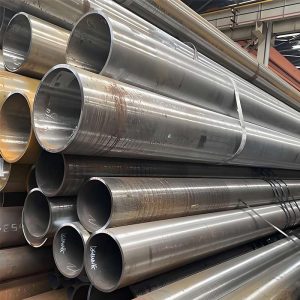
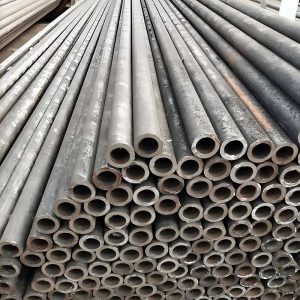
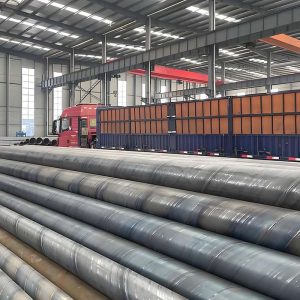
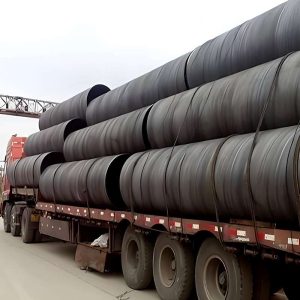
Spiral steel pipe is manufactured using a spiral welding process and features high strength, excellent pressure resistance, and high dimensional accuracy.
It is suitable for applications in the oil and gas, water conservancy, building pile foundations, and industrial piping sectors. It supports customization in multiple specifications and complies with international standards such as API 5L, ASTM, and GB/T.
II. Classification of Spiral Welded Steel Pipe Material Grades
| Material Grade | Type | Application |
|---|---|---|
| ASTM A252 Gr.1 / Gr.2 / Gr.3 | Carbon Steel | Piles, structural applications, low-pressure water pipes |
| ASTM A53 Gr.B | Carbon Steel | Water transmission, low-pressure steam pipes |
| API 5L B / X42 / X46 / X52 / X56 / X60 / X65 / X70 | Carbon Steel / Low Alloy Steel | Oil and gas pipelines |
| ASTM A106 Gr.B / Gr.C | Seamless high-temperature pipes | High-temperature steam, oil, and gas pipelines |
| Q235 / Q345 | Carbon Steel / Low Alloy Steel | Structural applications, bridges, and buildings |
Note: API 5L X42–X70 grades are commonly used for export-grade spiral pipes, while Q235/Q345 grades are typically used for domestic construction or low-pressure pipes.
III. Chemical Composition Table (Using API 5L Carbon Steel Spiral Welded Pipe as an Example)
| Material Grade | C (%) | Mn (%) | P (%) | S (%) | Si (%) |
|---|---|---|---|---|---|
| X42 | 0.18–0.22 | 1.20 | ≤0.030 | ≤0.030 | 0.15–0.35 |
| X46 | 0.18–0.22 | 1.30 | ≤0.030 | ≤0.030 | 0.15–0.35 |
| X52 | 0.18–0.22 | 1.40 | ≤0.030 | ≤0.030 | 0.15–0.35 |
| X56 | 0.18–0.22 | 1.50 | ≤0.030 | ≤0.030 | 0.15–0.35 |
| X60 | 0.18–0.22 | 1.50 | ≤0.030 | ≤0.030 | 0.20–0.35 |
| X65 | 0.20–0.26 | 1.50 | ≤0.030 | ≤0.030 | 0.20–0.35 |
| X70 | 0.22–0.28 | 1.50 | ≤0.030 | ≤0.030 | 0.20–0.35 |
IV. Mechanical Properties Table (API 5L Spiral Welded Steel Pipe)
| Material Grade | Yield Strength σs (MPa) | Tensile Strength σb (MPa) | Elongation δ5 (%) | Impact Value KV (J) |
|---|---|---|---|---|
| X42 | ≥ 290 | 415–530 | ≥ 23 | ≥ 34 |
| X46 | ≥ 315 | 415–535 | ≥ 22 | ≥ 34 |
| X52 | ≥ 359 | 450–580 | ≥ 21 | ≥ 34 |
| X56 | ≥ 379 | 485–620 | ≥ 20 | ≥ 34 |
| X60 | ≥ 414 | 485–625 | ≥ 20 | ≥ 34 |
| X65 | ≥ 448 | 510–690 | ≥ 19 | ≥ 34 |
| X70 | ≥ 483 | 540–710 | ≥ 18 | ≥ 34 |
V. Main Production Processes for Spiral Welded Steel Pipes
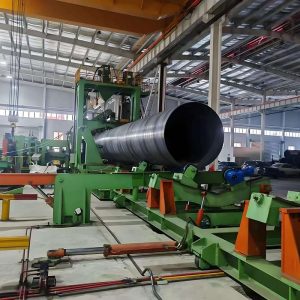
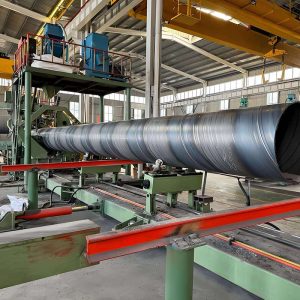
1. Spiral Submerged Arc Welding (SSAW / HSAW)
Principle: A steel strip is coiled into a pipe blank at a spiral angle, and then submerged arc welding is performed along the seam.
Features:
- Capable of producing large-diameter pipes (typically with an outer diameter ≥ 219 mm, up to 3000 mm or more)
- Flexible pipe lengths, customizable to customer requirements
- The weld seam is distributed spirally, ensuring uniform pressure distribution
Applications: Long-distance oil and gas pipelines, water conservancy projects, bridge pile pipes, and large-diameter structural pipes
2. Multi-pass Welding Technology (Optional)
For thick-walled spiral pipes, multi-pass welding (internal + external welding) may be employed to enhance weld strength and pressure resistance.
Features: Improves pipeline safety and reliability, particularly suitable for high-pressure pipelines.
VI. Types of Corrosion Protection for Spiral-Welded Steel Pipes and Their Applicable Environments
Spiral-welded steel pipes are used in projects such as oil and gas transmission, water supply, bridge construction, and building construction. Since they are constantly exposed to water, soil, air, or chemical media, they are prone to corrosion; therefore, selecting an appropriate corrosion protection method is crucial.
1. Paint Coating
- Features: Applying anti-rust paint or epoxy paint to the surface of steel pipes to form a physical barrier.
- Applicable Conditions:
Outdoor environments, under normal atmospheric conditions
Slightly humid environments, without direct contact with chemical media - Advantages: Simple application, low cost
- Disadvantages: Moderate durability, requires periodic maintenance
- Common Types: Primer + topcoat, epoxy coal tar paint
- Examples: Paint coating can be used for urban water supply pipes and spiral-welded pipes in bridge structures.
2. Epoxy Powder Coating (FBE / Fusion-Bonded Epoxy)
- Features: An epoxy powder coating is applied to the surface of steel pipes via electrostatic spraying and cured in an oven, resulting in a coating with strong adhesion.
- Applications:
Buried or underground pipelines
Medium- and low-pressure oil and gas transmission pipelines
Groundwater or damp soil environments - Advantages: Excellent corrosion resistance, wear resistance, and chemical resistance
- Disadvantages: Demands high-quality weld preparation; requires specialized equipment for application
- Typical thickness: 250–500 μm
- Examples: Long-distance natural gas pipelines, urban gas pipelines.
3. Hot-Dip Galvanizing
- Features: A zinc layer is formed on the surface of the steel pipe through hot-dip galvanizing; the zinc acts as a sacrificial anode to protect the steel pipe.
- Suitable Applications:
Outdoor atmospheric environments
Humid or neutral (non-acidic/non-alkaline) environments
Applications not directly exposed to high-pressure media - Advantages: Excellent durability and weather resistance
- Disadvantages: Not suitable for high-temperature environments; high-pressure pipelines require additional corrosion protection measures
- Common thickness: 50–100 μm
- Examples: Water supply pipelines, structural steel pipes in construction.
4. Internal Corrosion Protection (Epoxy Lining / PE Lining)
- Features: The inner walls of the pipeline are coated with epoxy or polyethylene (PE) to prevent corrosion by the transported medium.
- Applications:
Water supply pipes, drinking water pipes
Transportation of corrosive liquids
Prevention of sediment buildup - Advantages: Extends pipeline service life and prevents fluid corrosion
- Disadvantages: Higher construction costs; requires a clean and smooth inner surface
- Examples: Municipal water supply systems, seawater transmission pipelines.
5. Polyurethane/Glass Flake Composite Corrosion Protection (PU / GRP / FBE + Polyurethane)
- Features: Combines an epoxy coating with polyurethane or glass flake materials to form a composite protective layer
- Applications:
Highly corrosive environments (seawater, acidic or alkaline soils, chemical media)
High-pressure long-distance pipelines - Advantages: Corrosion resistance, high-temperature resistance, abrasion resistance
- Disadvantages: Complex application process, relatively high cost
- Examples: Subsea pipelines, chemical pipelines, pipelines for transporting acidic or alkaline liquids.
6. Conclusion
| Coating Type | Main Features | Applicable Environment / Service Conditions | Advantages | Disadvantages |
|---|---|---|---|---|
| Paint / Epoxy Paint | Surface coating | Outdoor, normal temperature, mildly humid | Low cost, easy to apply | Moderate durability, requires maintenance |
| FBE Powder | Epoxy powder film | Buried, oil & gas pipelines, moist soil | Excellent corrosion resistance, wear-resistant | High welding seam treatment requirements |
| Hot-Dip Galvanizing | Sacrificial zinc layer protection | Outdoor atmosphere, humid environment | Good weather resistance, durable | Not suitable for high temperatures, needs auxiliary protection for high pressure |
| Internal Epoxy / PE Lining | Internal corrosion protection | Water pipelines, corrosive liquids | Corrosion-resistant, medium-resistant | High cost, high construction requirements |
| PU / Glass Flake Composite | Composite protection | High corrosion, high pressure, seawater, chemical | Corrosion-resistant, wear-resistant, high temperature-resistant | Complex application, high cost |