
I. Why Choose Seamless Low-Carbon Steel Pipes as Structural Piping?
In modern construction and industrial engineering, steel pipes not only undertake the tasks of water and gas transportation, but are also key elements for structural support and framing. Seamless low-carbon steel pipes, due to their high strength, uniform wall thickness, good weldability, and machinability, have become an irreplaceable choice in engineering design and construction.
Structural low-carbon steel pipes are widely used in construction, machinery, bridges, and industrial plants. This article will analyze in detail the technical characteristics, advantages, selection points, and applications of seamless low-carbon steel pipes.
II. Basic Knowledge of Seamless Low-Carbon Steel Pipes
i. Seamless Steel Pipe Manufacturing Process
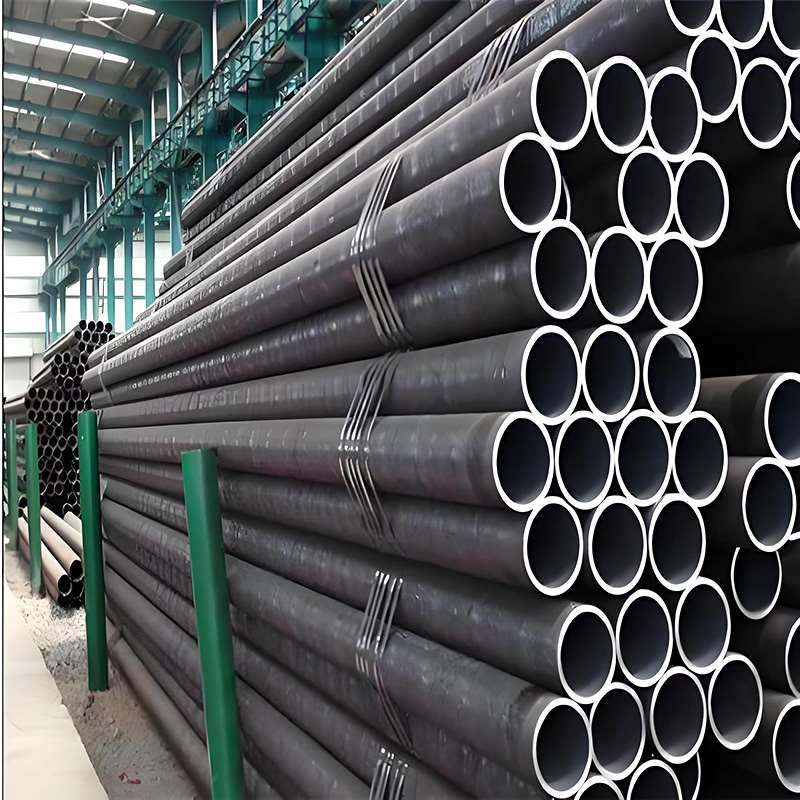
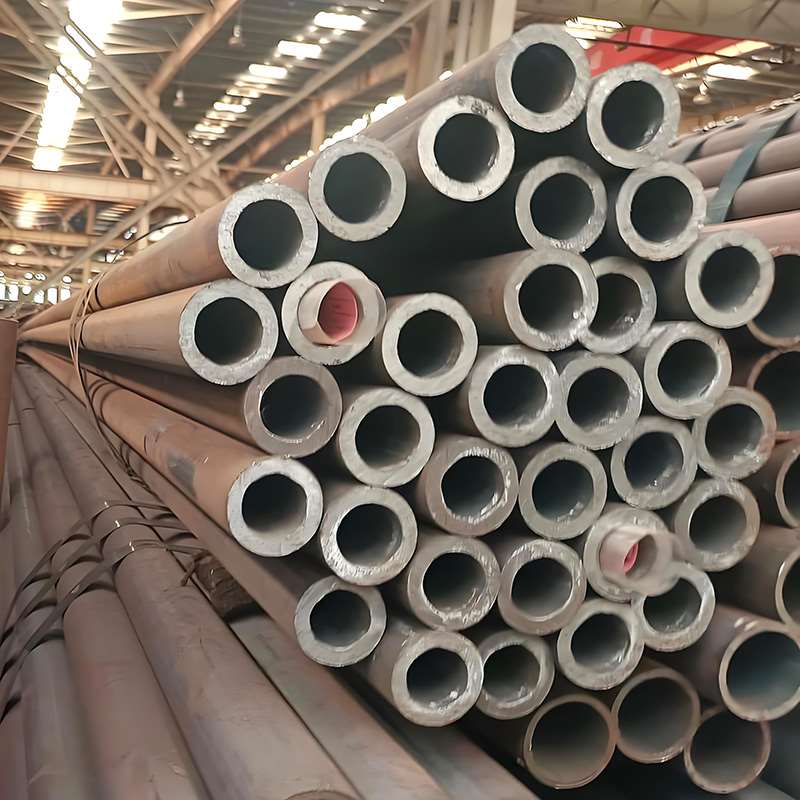
Seamless low-carbon steel pipes are typically produced using hot rolling or cold drawing processes, forming a round tube through integral stretching, without relying on welding. Compared to welded steel pipes, it has the following advantages: Uniform pipe wall thickness, no weld defects, and strong pressure resistance.
Smooth inner wall, excellent corrosion resistance, and reduced local stress concentration.
Stable length and diameter, facilitating structural processing and installation.
ii. Characteristics of Low-Carbon Steel
Low-carbon steel refers to steel with a carbon content ≤ 0.25%. Its main characteristics are:
| Parameter | Value Range | Effect on Structural Performance |
|---|---|---|
| Carbon (C) | ≤0.25% | Ensures weldability and toughness |
| Manganese (Mn) | 0.3–1.2% | Increases strength and hardness |
| Phosphorus (P) | ≤0.035% | Controls brittleness, ensures toughness |
| Sulfur (S) | ≤0.035% | Reduces risk of cracking |
| Yield Strength | ≥245 MPa | Ensures structural load-bearing capacity |
| Tensile Strength | 415–550 MPa | Provides sufficient safety margin |
| Elongation | ≥20% | Ensures plasticity for construction and machining |
iii. Common Specifications and Standards for Seamless Low-Carbon Steel Pipes
| No. | Standard | Type | Outer Diameter Range (mm) | Wall Thickness Range (mm) | Remarks |
|---|---|---|---|---|---|
| 1 | ASTM A106 | Seamless Carbon Steel Pipe | 21.3–660 | 2–50 | Commonly used for high-temperature and high-pressure fluid transport, exported to the US, Europe, etc. |
| 2 | ASTM A53 | Seamless/Welded Low Carbon Steel Pipe | 21.3–610 | 2–40 | Widely used for structural and fluid transport, exported to North and South America |
| 3 | ASTM A500 | Structural Seamless/Welded Steel Pipe | 15.9–323.9 | 2–16 | Mainly for structural applications, exported to the US and other countries |
| 4 | EN 10210 | Hot-Rolled Structural Steel Pipe | 60–426 | 3–50 | European standard, suitable for load-bearing structures and mechanical applications |
| 5 | EN 10216-1 | Seamless Steel Pipe | 15–660 | 2–40 | European standard, suitable for both structural and pressure piping |
| 6 | JIS G3452 | Seamless Steel Pipe | 21.7–610 | 2–40 | Japanese standard, commonly exported to Asian markets |
| 7 | GB/T 8162 | Seamless Steel Pipe for Fluid Transport | 21.3–530 | 2–25 | Chinese standard, partially exported to Asia and Middle East markets |
III. Advantages of Seamless Low-Carbon Steel Pipes in Structural Pipes
i. High Structural Integrity
Seamless construction ensures uniform wall thickness, stable load-bearing capacity, and reduced stress concentration.
Low susceptibility to cracking or localized failure under long-term use.
ii. Excellent Mechanical Properties
Low-carbon steel material (C≤0.25%) guarantees toughness and ductility.
Yield strength, tensile strength, and elongation meet structural load-bearing requirements.
Suitable for low-temperature or impact load environments.
iii. Flexible Processing and Construction
Weldable, cut, and bent, easy to install.
Dimensionally stable, standardized construction is more efficient.
iv. Durability and Corrosion Resistance
Smooth inner wall reduces corrosion risk.
External anti-corrosion treatments are available (PE coating, epoxy coating, anti-corrosion paint, etc.).
Low life-cycle cost and simple maintenance.
v. Wide Range of Applications
Building Structures: House frames, steel structure factory supports.
Industrial Machinery: Pipe racks, equipment supports. Municipal engineering: bridge railings, pipe corridors, pump station pipelines.
IV. Comparison Table of Seamless Low-Carbon Steel Pipes and Alternative Pipe Materials
| Comparison Dimension | Seamless Low Carbon Steel Pipe | Welded Steel Pipe | Ductile Iron Pipe | Plastic Pipe (PVC/PE) |
|---|---|---|---|---|
| Structural Integrity | High, uniform, no weld defects | Medium, weld may have stress concentrations | High, but brittle | Medium, easily deformed, low load-bearing capacity |
| Pressure Capacity | High | Medium | Medium | Low |
| Toughness & Impact Resistance | Excellent | Average | Lower | Poor |
| Machining Flexibility | High, weldable, cuttable, bendable | Medium | Low, requires special processing | Medium, bending requires heat or bending machine |
| Corrosion Resistance | Good, optional inner/outer coating | Medium, welds prone to corrosion | High, but prone to cracking | High, chemical resistant but low pressure capability |
| Service Life | Long | Relatively long, welds need attention | Long, but maintenance difficult | Medium, limited lifespan, unsuitable for high temperature or high pressure |
| Typical Applications | Building structures, mechanical supports, pipe racks | Low/medium-pressure pipelines, structural supports | Water supply, sewage, pipe galleries | Water supply, low-pressure pipelines, non-load-bearing uses |
V. Application Scenarios of Seamless Low-Carbon Steel Pipes
| Scenario Type | Specific Use | Recommended Size Example |
|---|---|---|
| Building Structure | House frames, steel-structure factory supports | φ60–φ219 mm, wall thickness 3–12 mm |
| Industrial Machinery | Equipment supports, pipe racks, support columns | φ42–φ168 mm, wall thickness 3–10 mm |
| Bridges & Municipal Works | Bridge guardrails, towers, pipe gallery supports | φ60–φ273 mm, wall thickness 4–16 mm |
| Special Projects | Crane trusses, stage steel frames, storage racks | φ32–φ168 mm, wall thickness 2–10 mm |
VI. Selection Considerations for Seamless Low Carbon Steel Pipes
| No. | Parameter Category | Recommended Selection | Notes / Considerations |
|---|---|---|---|
| 1 | Application Type | Structural supports, building frames, mechanical pipe racks, bridge trusses | Defining the purpose is the first step in selection; determines pipe diameter and wall thickness range |
| 2 | Standard / Material | Low carbon steel, compliant with GB/T 8162/8163 or ASTM A500/A106 standards | Ensures mechanical properties, weldability, and export requirements |
| 3 | Outer Diameter | 32–273 mm (commonly used) | Choose based on load capacity and spatial layout; medium/large diameters for main structure, small diameters for supports or equipment racks |
| 4 | Wall Thickness | 2–16 mm (commonly used) | Thicker walls provide higher load capacity but increase cost; select according to load and pressure requirements |
| 5 | Load-Bearing Capacity | Yield strength ≥245 MPa, tensile strength 415–550 MPa | Select according to structural design requirements to ensure safety factor |
| 6 | Corrosion Protection | Inner epoxy coating, cement mortar lining; outer PE coating, anti-corrosion paint | Light protection for indoor use; enhanced protection required for outdoor or humid environments |
| 7 | Connection Method | Welding (TIG/MIG/manual), flange connection | Select based on construction method; ensure weld quality |
| 8 | Machining Method | Cutting, bending, welding | Ensure low carbon steel toughness meets processing requirements |
| 9 | Applicable Environment | Indoor building structures, industrial plants, bridges, pipe galleries | Choose corrosion protection level according to temperature, humidity, and corrosive media |
| 10 | Economic Consideration | Comprehensive life-cycle cost | Include procurement, installation, maintenance, and service life; choose the most cost-effective specification |
VI. Construction Precautions for Seamless Low-Carbon Steel Pipes
1. Handling and Stacking
Handle pipes with care to avoid scratches or dents.
Stack pipes flat to prevent bending or deformation.
2. Welding
Use welding materials and processes suitable for low-carbon steel to ensure weld quality.
Clean the internal and external anti-corrosion coating before welding, and repair the anti-corrosion coating promptly after welding.
3. Pipe Support and Fixing
Ensure reasonable support spacing during installation to prevent pipe vibration and displacement.
Add necessary supports to load-bearing pipe structures to ensure safety and stability.
4. Corrosion Protection
Avoid damage to the anti-corrosion coating during hoisting, handling, or welding.
Apply anti-corrosion paint or sleeves to exposed pipes promptly.
5. Pressure Testing and Flushing
Conduct a pressure test after installation to confirm no leaks.
Flush the pipes to ensure internal cleanliness and absence of impurities.
6. On-Site Maintenance
Regularly inspect welds, anti-corrosion coating, and supports. For critical pipelines, ultrasonic thickness measurement or endoscopy can be used to inspect the internal condition.